
The Multifaceted Pentameter: Orthodox Variations
Shakespearean pentametric explorations. Mostly.

“True ease in writing comes from art, not chance,
As those move easiest who have learn’d to dance”
Alexander Pope, An Essay on Criticism
This is going to be an extremely thorough overview of how variation within iambic meter works, with a specific focus on what is historically the single most popular meter in the English language since at least the late 1500s: iambic pentameter, the five beat line. Penta- (as in pentagon, pentagram, or pentathlon) is a Greek prefix derived from pente, meaning “five”; so a line of pentameter is a line of five beats.
This post is long because I feel it necessary to have all this information in one spot for your convenience, but I have recommended two resting points along the way. You can, if you wish, treat this as three separate posts on one page - making it super easy for you to refer back to earlier segments. Best of both worlds!
If you’re reading this on a laptop, you can also see a Table of Contents if you click on the small horizontal lines on the left hand margin.
I will be using Shakespeare as a primary source. Not only was Shakespeare masterful in his expressive employment of meter, but he employed interesting additional variations in his dramatic verse, specifically - variations which have often been freely used by modern metrists.
But some guide notes before we enter the pentametric forest…
What is iambic meter?
It is a line in which, as a default, the beats land on every other syllable, in an undulating pattern: di-dum-di-dum-di-dum-di-dum…
This is an accentual-syllabic meter, meaning it is defined by a beat pattern.1
How are beats recognised?
Through stress placement. An iambic rhythm is maintained when every other syllable has greater or equal stress (usually greater) to the previous syllable.
What defines stress?
In English, stress is primarily defined by pitch: we hear higher pitched syllables as the stressed syllables. Stress is relative: a syllable may have any degree of stress relative to an adjacent syllable (including equal stress).
Stress can also affect vowel quality.
Some people think they can’t recognise stress. If you are one, I will ask you to read this sentence, containing two different but identically spelt words:
I present a present.
Can you hear the difference between the first and second example of “present”? If so, congratulations, because the only difference between these two words is their stress placement, so you are hearing stress!
Here are the stresses in bold:
I present a present.
These two identically spelt but differently stressed words also serve to illustrate how stress can affect vowel quality.
“Present” is pronounced “prizzent”. “Present” is pronounced “prezzunt”.
The “u” in “prezzunt” is intended to represent the neutral “uh” vowel we hear at the end of “huh” or “the”. This vowel is called a schwah, and it is the most neutral vowel sound you can make: if you allow your jaw and tongue to relax, and then vocalise (think “Duh!”), the sound you make will be a schwah! In phonetics, it’s represented by an upside down e, and it is, in fact, the most common vowel sound in English.
The short “i” in “prizzent” is the second most neutral vowel (just a slight tightening). So in both cases, the stressed vowel is an open “eh”, and the unstressed vowel is more neutral.
Here’s another example, where I hope you can work out for yourself where the stresses land, and how the stress placements affect the vowels:
A rebel rebels.
And click here for a list of identically spelt, differently stressed, word pairs.
For those of you who previously thought you couldn’t recognise stress, please do let me know if you found this helpful!
Syllable Duration
Syllables also receive emphasis through duration, and while a stressed syllable will typically have greater duration than the same syllable unstressed (so duration could be said to reinforce stress), it won’t always have greater duration than an adjacent unstressed syllable.
For instance, take this compound word:
Popcorn
When we say “popcorn”, we automatically pronounce the first syllable at a higher pitch: that is the stressed syllable. However, the second syllable, “corn”, has greater duration.
You can also hear in the word “embittered” how the middle, stressed syllable is of shorter duration than the other two.
The variable interplay between stress and duration is an integral aspect of prosodic texture and expression.
What is iambic pentameter?
It is a line of five beats in which, as a default, the beats land on every other syllable, in an undulating pattern:
di-dum-di-dum-di-dum-di-dum-di-dum
You might have noticed my repeated qualifier: “as a default”. If you’re ready, here begins our exploration of iambic variation…
Beat Shifts: the Swing & the Pump
A fuller definition of iambic pentameter: it is a line of five beats in which the beats land on every other syllable, and in which a beat can be either pulled back a space or pumped forward a space under certain conditions.
Here is an unvaried line with the beats marked off and italicised:-
When I | do count | the clock | that tells | the time
di-dum | di-dum | di-dum | di-dum | di-dum
Here is an example of a beat being pulled back:-
Now is the time | that face | should form | another
dum-di-di-dum | di-dum | di-dum | di-dum-di
This “dum-di-di-dum” pattern is a swinging movement from one post to the next (pulling back a beat is similar to lifting a pendulum: once lifted, you simply release. If you pause too heavily after the first syllable, the rhythmic swing is broken - like yanking the pendulum off its chain and throwing it, instead of simply releasing its stored gravitational energy! It’s a misdelivery I hear all too frequently, breaking the meter, and robbing the line of its energy). I call this pattern, quite simply, a swing.
This line also contains what is traditionally called a feminine ending2, though I call it a tail: an extra offbeat at the end of the line (“di-dum-di”, instead of “di-dum”).
And here is an example of a beat being pumped forward:-
Affec | tion, puh. | You speak | like a green girl
di-dum | di-dum | di-dum | di-di-dum-dum
I call this “di-di-dum-dum” pattern, quite simply, a pump.
These are rhythmic syncopations.
The Spondee & the Catch
There is also one very particular (and less frequent) metrical pattern that combines a beat shift with a spondee. A spondee occurs when an offbeat syllable is stressed: “dum-dum”, instead of “di-dum” (in contrast to beat shifts, which are achieved through swapping the stress of two adjacent syllables, the spondee is an example of a variation achieved through adjusting the stress of a single syllable). Here’s an example of two consecutive spondees:-
Rich gifts | wax poor | when gi | vers prove | unkind
The beat is marked by every other syllable (“gifts”, “poor”, “gi-”, “prove”, “-kind”), however, the offbeats “Rich” and “wax” also receive a full stress, creating a heavy emphasis which commands our attention. Even more emphatic is this rare example of three consecutive spondees:-
Thoughts black, | hands apt, | drugs fit, | and time | agreeing
And here’s some single spondees - which I’ll {bracket}:-
And wrinkled deep in time. {Broad fron}ted Caesar,
From sullen earth, {sings hymns} at heaven’s gate;
{Sap checked} with frost and lusty leaves {quite gone}
Here, I also bracket a pump:
{Past rea}son hun{ted, and no soo}ner had,
Now, as I said, there is one unique metrical pattern which combines a beat shift with a spondee: normally, when a beat is pulled back a space, it creates a swing (“dum-di-di-dum”; “Now is the time…”); however, when this beat shift is combined with a spondee, it creates the pattern “dum-di-dum-dum”:-
{Claps her pale cheek}, till clapping makes it red
{dum-di-dum-dum}, di-dum-di-dum-di-dum
I call this pattern a catch.
Both this pattern and the pump (di-di-dum-dum) are lopsided metrical patterns (they lack the symmetrical balance of the swing: dum-di-di-dum), and therefore, typically, rely on the support of a grammatical structure to ensure rhythmic cohesion.3 The grammatical structure for the catch is often (though not always) the very one from the previous quote:-
Verb (“Claps”)/small connecting word (in this case, the pronoun “her”)/monosyllabic adjective (“pale”)/ noun (“cheek”)
And the pump often follows the exact same grammatical structure on the last three syllables: small connecting word / monosyllabic adjective / noun. Indeed, it’s the frequency of this “di-dum-dum” stress pattern - due especially to the frequency of this particular pattern of syntax - that necessitated the development and universal adoption of these two metrical variations.4 Here’s a line that contains both patterns:
{Pluck the keen teeth} {from the fierce ti}ger’s jaws
{dum-di-dum-dum} {di-di-dum-dum}-di-dum
It is also important to note that when a beat is pulled back, this displaced beat is typically placed either at the opening of the line or after a break within the line, as a preceding pause, however slight, is required to register the beat shift. Here’s an example of a catch occurring mid-line (and also a very nice example of how expressive metrical variation can be):-
From ancient grudge {break to new mu}tiny
di-dum-di-dum {dum-di-dum-dum}-di-di
Though there is no punctuation mark, there is a clear phrasal break and natural pause after the word “grudge” (“From ancient grudge / break to new mutiny”). In this case, the break is marked by the emphatic displaced beat on the word “break”! Which also echoes the “ancient grudge” through assonance: the shared vowel sound of “break” and “ancient”. And the spondee, too, is given heightened emphasis through assonance: the shared “u” sound of “new mutiny”.
Pyrrhics & Slides
In that last line, the final beat is light, creating the flourish of two light syllables at the end. When you have a light beat (“di-di”, instead of “di-dum”), this is known as a pyrrhic (the “y” is pronounced with a short “i” sound, as in “tip”). In this case, it is an appended pyrrhic: a pyrrhic at the end of a word (“mu-ti-ny”). A pyrrhic at the end of a line or before a line break is likely to be an appended pyrrhic. When there is no line break, the light beat opens up a run of light syllables which provide heightened emphasis to the next heavy beat: instead of “di-dum-di-dum”, we have the pattern “di-di-di-dum”:-
My boun{ty is as bound}{less as the sea}
di-dum-{di-di-di-dum}{di-di-di-dum}
The beat syllables “is” and “as” are light, creating runs of light syllables which serve to highlight the heavy beats on “boundless” (echoing “bounty”) and “sea”.
I call this “di-di-di-dum” pattern a slide.
The Golden Line
This particular construction, with two successive slides, I call the golden line, and it highlights the default 3-beat rhythm of the pentameter line!
As a default, we hear beats in pairs, and in pairs of pairs:
di-dum-di-dum | di-dum-di-dum
Four beats: the tetrameter (“tetra-” being the Greek prefix for “four”, as in tetralogy). That grouping of four - of a pair of pairs - is how we automatically tend to group any long, undifferentiated string of beats, such as:
di-dum-di-dum-di-dum-di-dum-di-dum-di-dum-di-dum-di-dum-di-dum-di-dum-di-dum-di-dum-di-dum-di-dum-di-dum-di-dum…
Our first rhythmical impulse is to group such a string like so:
di-dum-di-dum-di-dum-di-dum || di-dum-di-dum-di-dum-di-dum || di-dum-di-dum-di-dum-di-dum || di-dum-di-dum-di-dum-di-dum…
Four beats fills out a bar, as it were: 4-beat lines roll out evenly, with no automatic pause. And our further impulse is to group rhythmic units into pairs of pairs - which is most clearly visually demonstrated if we stack each of those 4-beat units on top of each other:
di-dum-di-dum-di-dum-di-dum
di-dum-di-dum-di-dum-di-dum
di-dum-di-dum-di-dum-di-dum
di-dum-di-dum-di-dum-di-dum
A 4-line stanza is called a quatrain. This quatrain is composed of four lines of four beats: a perfect square.5 Scaling up again would take us to four such stanzas!
We can compare a quatrain of 3-beat lines6 (or trimeters):
di-dum-di-dum-di-dum
di-dum-di-dum-di-dum
di-dum-di-dum-di-dum
di-dum-di-dum-di-dum
Read that out loud and you’ll find you automatically pause at the end of each line. Why? Because you’re missing that final 4th beat to fill out the bar:
di-dum-di-dum-di-dum (di-dum)
di-dum-di-dum-di-dum (di-dum)
di-dum-di-dum-di-dum (di-dum)
di-dum-di-dum-di-dum (di-dum)
You could call that pause a “phantom” beat.7 Trimeter = tetrameter with a phantom 4th beat!
And the pentameter? Well, here it gets interesting.
In the pentameter, the default is three primary beats separated by two secondary beats:
di-DUM-di-DUM | di-DUM-di-DUM | di-DUM
when I do COUNT | the CLOCK that TELLS | the TIME
Because we tend to hear beats in pairs, and because opening and closing beats tend to register more strongly, the default we hear with five beats is an enlarged primary 3-beat rhythm on the 1st, 3rd & 5th beats. This default rhythm is brought into sharp relief when the even-numbered beats are light:
My bounty is as boundless as the sea
His Ministers of vengeance and pursuit8
Tomorrow and tomorrow and tomorrow
This enlarged default rhythm is less obvious, more subtle, than in shorter meters.9 And, again, there’s that qualifier: “default”. In practice, the rhythms of the pentameter vary with enjambment (when the phrase runs over from one line into the next), and with the placements of caesuras (breaks within the line) and light beats.
For instance…
The Balanced Line
di-dum-di-dum-di-di-di-dum-di-dum
King Richard resigns himself to giving up the crown:-
I’ll give my jewels for a set of beads
Wilfred Owen describes the victims of “The old Lie”:-
To children ardent for some desperate glory
Simply through lightening the stress of the middle beat, demoting it to secondary status relative to the heavy pairs of beats on either side, the line immediately flips from an an enlarged 3-beat rhythm to a syncopated 4-beat rhythm.10
The pentameter is unique in possessing both an enlarged default 3-beat rhythm, and (unlike the hexameter11) a refusal to divide into equal parts. It’s uniquely dynamic: tighter and springier than the hexameter; more subtle and varied than the rhythmically insistent short meters. This is why Shakespeare and his contemporaries employed the pentameter for dramatic speech, but short meters for songs and chants.
And here we reach our first perfect place to pause. Resume at your leisure!
The March
The other simple variation is to add weight to a syllable within a phrase (rather than at the opening of a line or phrase): instead of “di-dum-di-dum”, we have “di-dum-dum-dum” (in this case, as a default, the heavy offbeat will fall in pitch to some degree relative to the heavy beats either side12). I call this a march:-
{And dig deep tren}{ches in thy beau}ty’s field
{di-dum-dum-dum}{di-di-di-dum}-di-dum
The above example opens on a march, before releasing into a swift slide.
Here’s a march later in the line:-
And summer’s lease {hath all too short} a date
This next example, from the “log scene” in The Tempest, when Ferdinand declares his love to Miranda, contains two consecutive lines that open on a march:-
                                                                  …I,
{Beyond all li}{mit of what else} i’th’ world,
{Do love, prize, ho}nor you.
And this is the context:-
Miranda
Do you love me?

Ferdinand
O heaven, O earth, bear witness to this sound,
And crown what I profess with kind event
If I speak true; if hollowly, invert
What best is boaded me to mischief. I,
Beyond all limit of what else i’th’world,
Do love, prize, honor you.

Miranda
I am a fool
To weep at what I am glad of.

Prospero
Fair encounter
I never hear actors delivering that final line of Ferdinand’s metrically: they always linger on the first two stressed words, which leads them to drop the emphasis on the last (and all important) word, “you”:-
Do LOVE… PRIZE… HOnor you.
di-dum…dum…dum-di-di.
This delivery is essentially accentual, not accentual-syllabic: each of the three stressed syllables is separated into its own temporal beat, leaving the two remaining syllables to trail off insignificantly (that exaggerated spacing of the three stresses prevents that final syllable from being heard, temporally, as a light beat).
A metrical delivery is far more lively:-
                                                                               …I,
beYOND ALL LImit of what ELSE i’th’WORLD
Do LOVE, PRIZE, HOnor YOU!
di-dum, dum, dum-di-dum!
This not only echoes and builds on his earlier words, “If I SPEAK TRUE”, but quite delightfully, it allows Miranda to pick up that same energy, completing his line with a swing:-
Do love, prize, honor you. || I am a fool
To weep at what I am glad of.
(And Prospero, spying on them unseen, completes his daughter’s line in turn, immediately picking up the beat: “Fair encounter”. And while “fool” is a near assonance with “you”, “Fair”, in turn, alliterates with “fool”.)
Note also how the required contraction of Miranda’s “I am” in the second line (to one and a half syllables, “eye-um”, rather than a monosyllabic “I’m”) conveys the same surge of emotional energy as my reading of Ferdinand’s delivery.
The key word, for Ferdinand, is “YOU”! “Beyond anything else in the WORLD, I prize YOU!” (a final emphasis which beautifully matches his opening emphasis on “I” - which simultaneously opened his final sentence and concluded a line!) The usual delivery, by contrast, can easily end up being insipid.
Hybrids
Slide-march hybrid
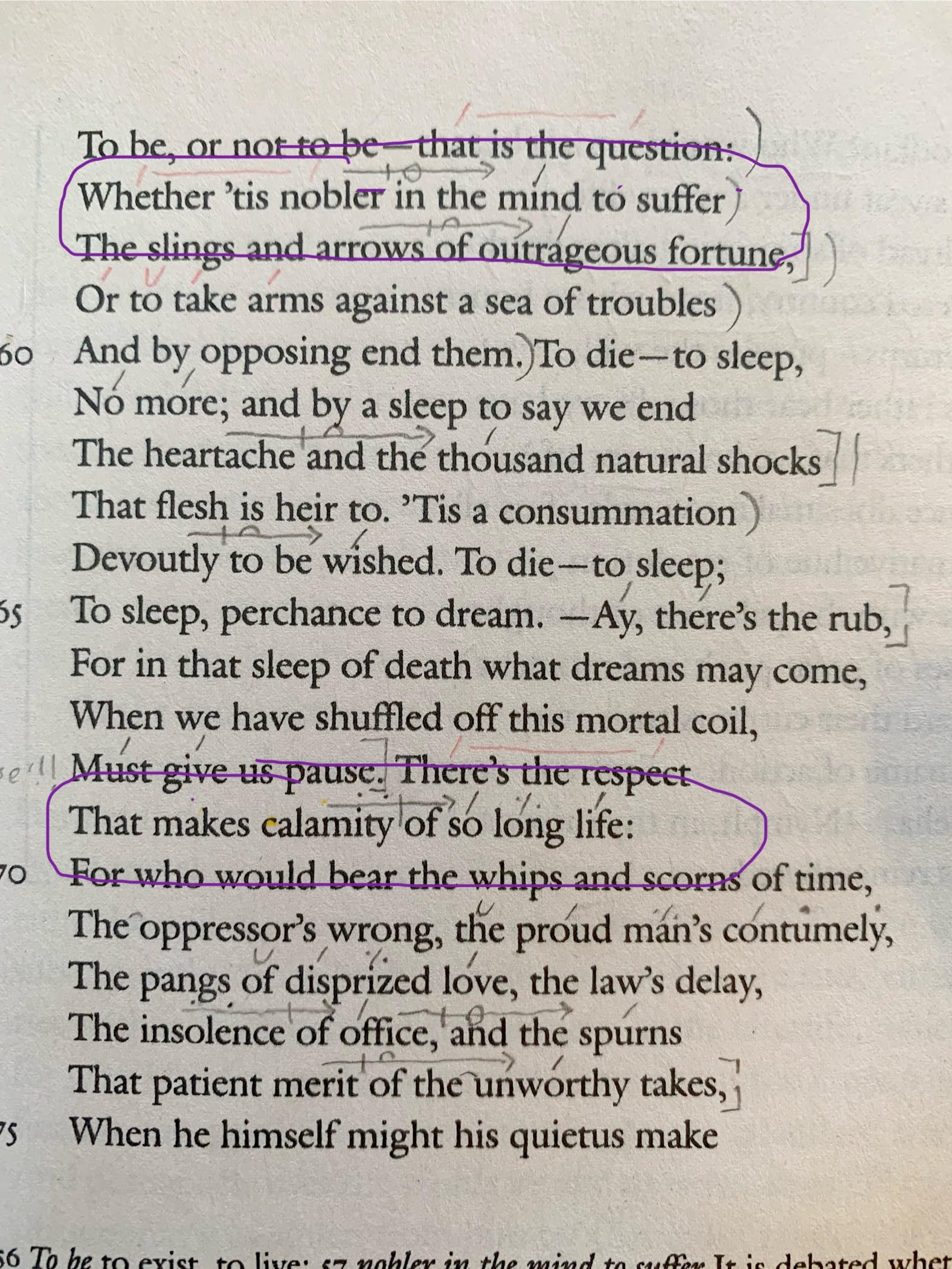
                          …There’s the respect
That makes calamity of so long life.
Thus speaks Hamlet before passionately enumerating “the whips and scorns of time” which we would surely never choose to endure were it not for “the dread of something after death”.
I hope you can identify the variation at the end of that first line (opening the sentence on an enjambment):
…There’s the respect
But can you work out what’s going on at the end of the second?
That makes calamity of so long life.
Here’s where a light beat results in a slide:
That makes cala{mity of so} long life.
And here’s where a heavy offbeat results in a march:
That makes calamity {of so long life}.
They overlap! Here’s both patterns marked individually, with the march marked in [square brackets], to make the overlap clear:
That makes cala{mity [of so} long life].
di-dum-di-dum-{di-di-[di-dum}-dum-dum]
It’s a slide-march hybrid: three light syllables running into three heavy syllables.
That makes cala{mity of so long life}.
di-dum-di-dum-{di-di-di-dum-dum-dum}
Say it out loud, with conviction, and you swoop straight into the oppressiveness of those three long monosyllables: “...soooo lonnng life.” His weariness is palpable!
Another example from Shakespeare’s concluding sonnet (“quen-ched” is disyllabic):-
{This brand} she quen{ched in a cool well by},
The same end-line run of light, short vowelled syllables into heavy long vowelled syllables sonically conveys the depth and coolness of the well.
Swing-march hybrid
Similarly, a heavy offbeat can land straight after a swing, producing an overlap between a swing and a march. Here’s Juliet, reluctantly tearing herself away from her Romeo:-
Good night, good night. Parting is such sweet sorrow,
Here’s the swing marked, after the full stop, where a beat is pulled back:
{Good night}, {good night}. {Parting is such} sweet sorrow,
And here’s the march marked:
{Good night}, {good night}. Parting {is such sweet so}rrow,
Here’s the swing and the march marked separately, with the march in [square brackets], showing the overlap:
{Good night}, {good night}. {Parting [is such} sweet so]rrow,
{dum-dum}, {dum-dum}. {dum-di-[di-dum}-dum-dum]-di
And the swing-march hybrid marked as a unified pattern:
{Good night}, {good night}. {Parting is such sweet so}rrow,
{dum-dum}, {dum-dum}. {dum-di-di-dum-dum-dum}-di
In this particular instance, the line ends on a tail (drooping expressively in “sorrow”).
The lifting lilt of the swing into the fullness of her drawn out sigh is quite enchanting, don’t you think?
Thump & Pump, Stomp & Slide
The spondee, with its opening heavy offbeat (opening either a line or phrase), can also, in its own way, combine with larger patterns.
Thump & pump
Gertrude, in sheer exasperation at the windbag Polonius’ verbosity:
More matter with less art
{More ma}{tter with less art}
{dum-dum}{-di-di-dum-dum}
A pump springs forth from an opening spondee, producing this strikingly robust symmetrical stress pattern (like a compressed balanced line!)
And this is from Sonnet 140:
{Mad sland’rers by mad ears} believed be
(“be-liev-ed”: the “-ed” is pronounced separately)
Here’s an example from Sonnet 2 of Elizabeth Barrett Browning’s Sonnets from the Portuguese:
{Thee speaking and me list}ening! and replied
(“listening” is contracted to two syllables)
Her husband, Robert Browning (to whom her sonnet sequence is devoted), wrote this of her after her death:
{O ly}ric love, {half angel and half bird},
And bringing us into the 20th century, the opening line of Robert Frost’s Desert Places:
{Snow falling and night fa}lling fast, {oh, fast}
These are simply the examples I’ve stumbled across by chance while keeping an eye out for this pattern, and yet they all have a similar rhetorical feature: either repeated or contrasting words in each double stress:
More matter / less art
Mad / mad
Thee speaking / me listening
half / half
Snow falling / night falling
Stomp & Slide
Here a slide flows forth from an opening spondee:
{Full cha}{racter’d with las}ting memory,
{Full character’d with las}ting memory,
dum-dum-di-di-di-dum…
More examples:
{Not wond’ring at the pre}sent nor the past,
{Now proud as an enjoy}er, and anon
{So fastened in her arms} Adonis lies
{Throw physic to the dogs}; {I’ll none} of it.
{Doth homage to his new} appearing sight
That last is an example of ambiguous stress level: “Doth” could easily be pronounced with full stress - or with somewhat lesser stress, making the opening a heavy iamb rather than a full spondee.
Here’s the pattern combined with a slide-march hybrid:
{Unlear}{ned in the world’s false sub}tleties.
Unlearned in the world’s false subtleties.
And here’s the pattern within a golden line:
{Rain a}{dded to a ri}{ver that is rank}
Rain added to a river that is rank
And another perfect resting point!
Split Forms
The split swing
Occasionally, a swing is split in the middle, producing a clear divide between the fall and subsequent rise:-
{Soft you, a word} or two before you go.
{Justice, the law}, my du{cats, and my daugh}ter!
{Savage, extreme}, {rude, cru}el, not to trust;
The simple catch
A similar effect is produced when the first two syllables of a catch belong to a disyllabic word: a simpler 2-step rhythmic variation:-
{Clarence still breathes}, {Edward still lives} and reigns
Unlike with the standard catch, we can place a divider in the middle of the pattern without obscuring the rhythm:-
Clarence | still breathes, | Edward | still lives | and reigns
The steady, considered emphasis and repetition of these 2-syllable words and phrases dropping from Richard’s mouth, with the opening falls on the names of his brothers, is deeply menacing.
Another example:
Beauty o’ersnowed | and bareness ev’rywhere,
Beauty | o’ersnowed | and bareness ev’rywhere,
Here, the heavy blanketing of “o’ersnowed” is felt sonically - especially in contrast to the prevailing falling rhythm of the rest of the line (“Beauty…bareness ev’rywhere”).
Not a pump!: stress pattern v beat placement
When an appended pyrrhic meets a spondee, they form an identical stress pattern to the pump - but with no beat shift!
Uncer{tainties now crown} themselves assured
Like as, to make our a{ppetites more keen}
{Ay, do!} Persever: coun{terfeit sad looks}
The last syllable of an appended pyrrhic has a stronger connection backwards than forwards, because it belongs to the same word as the previous beat syllable (beautiful, uncertainties, appetites, counterfeit). You can plonk a double stress after it, and it makes no difference to the beat placement! It’s comparable to the split swing and simple catch in that it’s the stress pattern of a pump divided into halves - but in this case, the division regularises the beat placement!
Split Spondees
A heavy offbeat which opens a line or phrase is sonically indistinguishable from a beat, and so is only retrospectively identified as an offbeat by the arrival of the succeeding beat syllable. This catches the ear - and the effect is heightened further when the two syllables are separated through punctuation.
The opening monosyllabic word may be an exclamation:
{O, she} doth teach the tor{ches to burn bright}
{O, give} thyself the thanks, if aught in me
{O, how} thy worth with manners may I sing
{Ah, where}fore with infection should he live,
(Very open to interpretation how much or little emphasis to place on “with” & “should”)
We earlier saw this end-line example from Robert Frost:
{Snow falling and night fa}lling fast, {oh, fast}
It may also be either a negation or affirmation (the first example is another we saw earlier; this time I’ll mark the appended pyrrhic and spondee separately):
{Ay, do!} Persever: coun{terfeit} {sad looks}
{No, Time,} thou shalt not boast that I do change
(Plenty of leeway here as to how much emphasis you might place on “not” & “do”)
                  {No, this} my hand will rather
The multitudinous seas incarnadine,
(“multitudinous” is contracted to four syllables: “multitud’nous”)
To sleep, perchance to dream; {ay, there’s} the rub
It can also be an instruction or plea (the first example is from Elizabeth’s 4th sonnet):
{Hush, call} no echo up in further proof
Of desolation!
(There’s leeway in how much emphasis to place on “no”)
{Hear, Na}ture, hear, {dear Go}ddess, hear
Or a word within a list of objects (two split spondees in this example):
{Pins, woo}den pricks, {nails, sprigs} of rosemary
Or some other kind of list, or piling on of descriptions or qualifications (this first, opening on the split swing we looked at earlier, follows up with a split spondee):
{Savage, extreme,} {rude, cru}el, not to trust;
{Had, ha}ving, and in quest to have extreme;
{Grows, lives,} and dies, in single blessedness.
And here, a split spondee within a stomp & slide (and capped with a dramatic swing!):
{Harsh, featureless and rude,} {barrenly pe}rish
More examples:
{I, sick} withal, the help of bath desired,
{Then, gen}tle cheater, urge not my amiss,
{Then, soul,} {live thou} upon thy servant’s loss,
{Since, spite} of him, {I’ll live} {in this poor rhyme,}
We certainly notice when the same word is repeated twice over:
{Rest, rest,} perturbed spirit.
…or, for that matter…
{Rage, rage,} against the dy{ing of the light}.
A couple more examples of opening split spondees:
King, father, ¦ royal Dane.
Seems, madam? ¦ Nay, it is. I know not ‘seems’.
These last two, I marked where a heavy beat picked up from a lyric caesura13: a caesura after an offbeat. The following beat lands with renewed emphasis.14 In the last example, the emphatic “Nay” is nicely framed by the bookended sarcastic repetition of “seems”!
This line, from Elizabeth Barrett Browning’s Sonnet 29 in Sonnets from the Portuguese, similarly opens on a split spondee, then has a post-caesura beat pick up, or renew, that opening emphasis:
{Yet, O} my palm-tree, ¦ be it understood
Six lines later, she combines an opening spondee with a split spondee after a pause15 in the same line:
{Drop hea}v’ly down,..{burst, sha}ttered ev’rywhere!
Drop heav’ly down,..burst, shattered ev’rywhere!
I added the metrically implied contractions myself, which here are beautifully expressive: how much more sudden and “heavy” is that “drop” for the contraction! And how striking, on the release from the mid-line pause, that falling “DUM, DUM-di, DUM-di-di” with each successively lengthened word!
The latter is a trick employed in a very different context by that master orator, Mark Anthony:
{Friends, Romans, Countrymen}, {lend me your ears}
Whereas Elizabeth’s line volently dissipates at the end, Mark Anthony’s opens with a building inclusiveness, reaching out to his audience, before making his formal request for their attention on a commanding swing.
Having quoted Dylan Thomas’ famous line earlier, I’ll close this segment with a look at the first two lines of the final stanza of that same poem:
And you, my father, ¦ there {on the sad height,}
{Curse, bless,} me now {with your fierce tears,} I pray.
The lyric caesura and split spondee, in lines 1 and 2 respectively, are followed up with the crescendo of a pump.
The beat after the lyric caesura and the beat syllable of the split spondee are a close assonance: the short “eh” of “bless” is a tightening up of the long “air” of “there”. Similarly, in the near rhyming beats of the final pump, the unvoiced S of “fierce” is transformed into the voiced Z of “tears”.
And the split spondee itself is composed of antonyms!
While understanding the principles of metrical variation is essential, it is not the be-all & end-all when developing an ear for the rhythms and points of emphasis within metered verse.
Enjambment, caesuras, rhyme & repetition, the rearrangement of syntax, the shape of individual words & phrases, consonant clusters, the texture and length of the individual phonemes16 - all these factors operate within the metrical framework, with its established range of elasticity, and are inseparable from it. Internalising the abstract metrical principles at play is only your starting point!
The Swing & Slide
4-syllable patterns can, of course, combine (you saw earlier how a march can release into a slide). I’m pointing up this particular combination because it’s employed so frequently, and to such striking effect. Here’s a famous example:-
Now is the winter of our discontent
{Now is the win}{ter of our dis}content
{dum-di-di-dum}{-di-di-di-dum}
dum-di-di-dum-di-di-di-dum
A swing into a slide. Though in this case, due to the weight lent to the penultimate syllable by the “…sc…nt….” consonant clusters, this can be scanned as a swing into a slide-march hybrid:-
{Now is the win}{ter of our discontent}
The distinctiveness of this combined stress pattern may be partly why the line is so memorable.17
And from the cold blooded, murderous Richard to an innocent, helpless infant:-
…At first the infant, Mewling and puking in the nurse’s arms;…At first the infant, {Mewling and pu}{king in the nur}se’s arms;
More examples:
Whether ’tis nobler in the mind to suffer
{Whether ’tis no}{bler in the mind} to suffer
Something is rotten in the state of Denmark
{Something is ro}{tten in the state} of Denmark
Come in the rearward of a conquered woe
{Come in the rear}{ward of a con}quered woe
The slide can also be delayed with an iambic stutter after the swing:
In the corrupted currents of this world
{In the corrup}ted cu{rrents of this world}
Paper Scansion: Examples
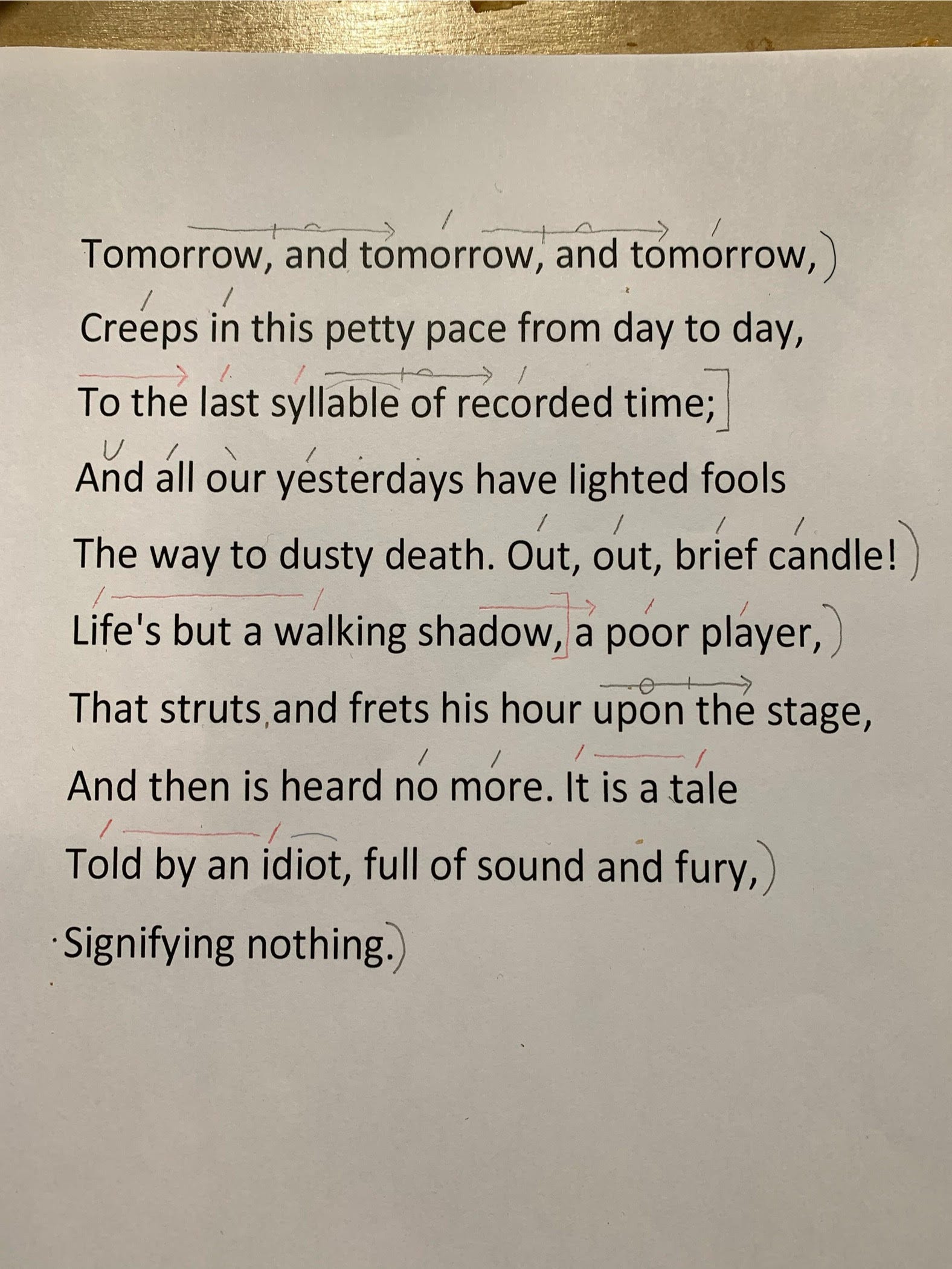
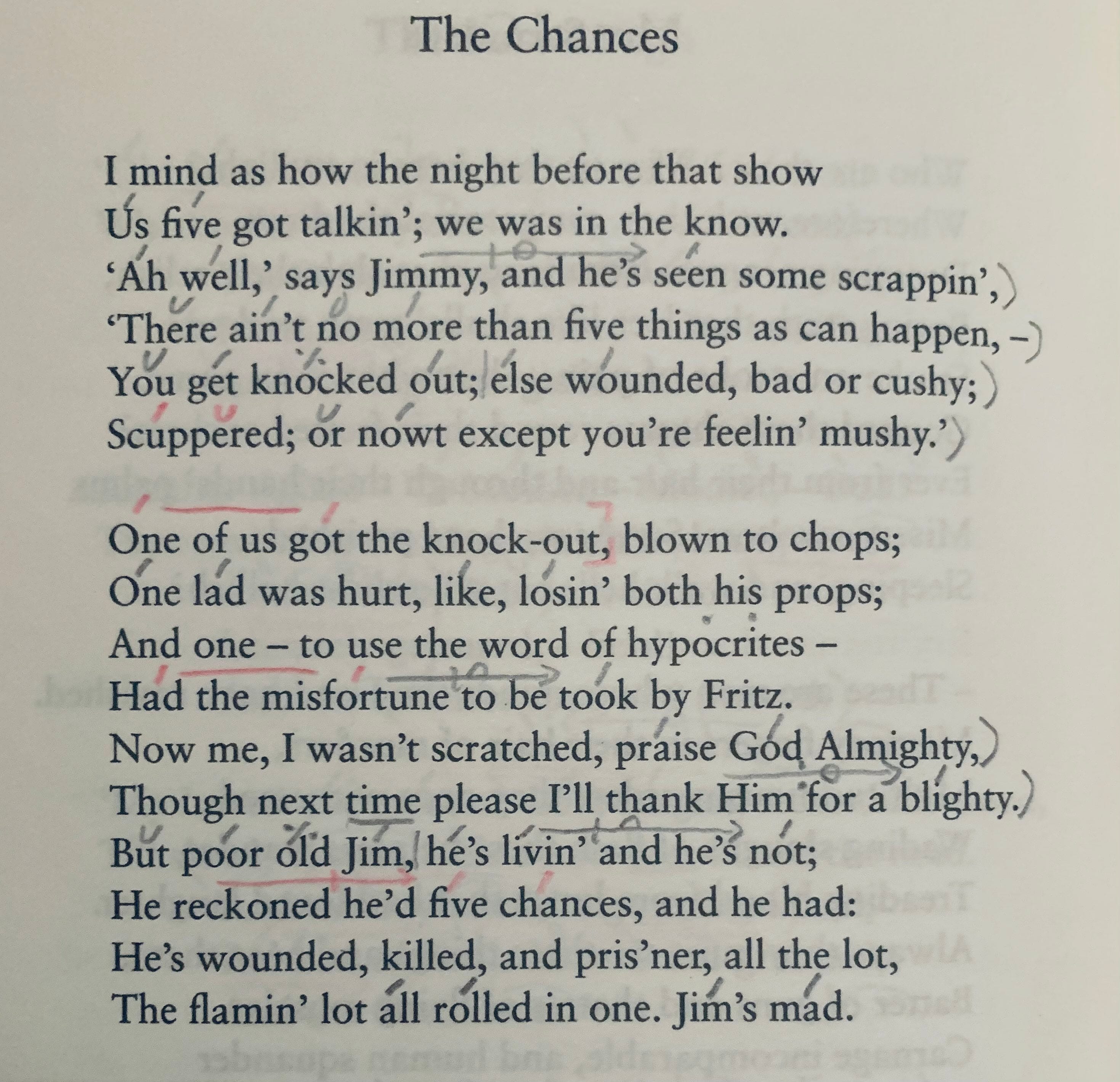
I thought it might interest you to see my own approach to scansion (the metrical reading of a line) on paper.
I mark patterns containing a beat shift in red (I would have made use of colour coding in this post, but Substack editing tools don’t provide that option, alas!)
Strings of light syllables I mark with arrows - or in the case of the two light syllables in the middle of a swing, a simple line between the beats. In the case of the slide, I mark the light beat with a semi-circle - or a full circle if I feel it may be of intermediate stress.
From Macbeth:
A sonnet by the magnificent Gwendolyn Brooks:
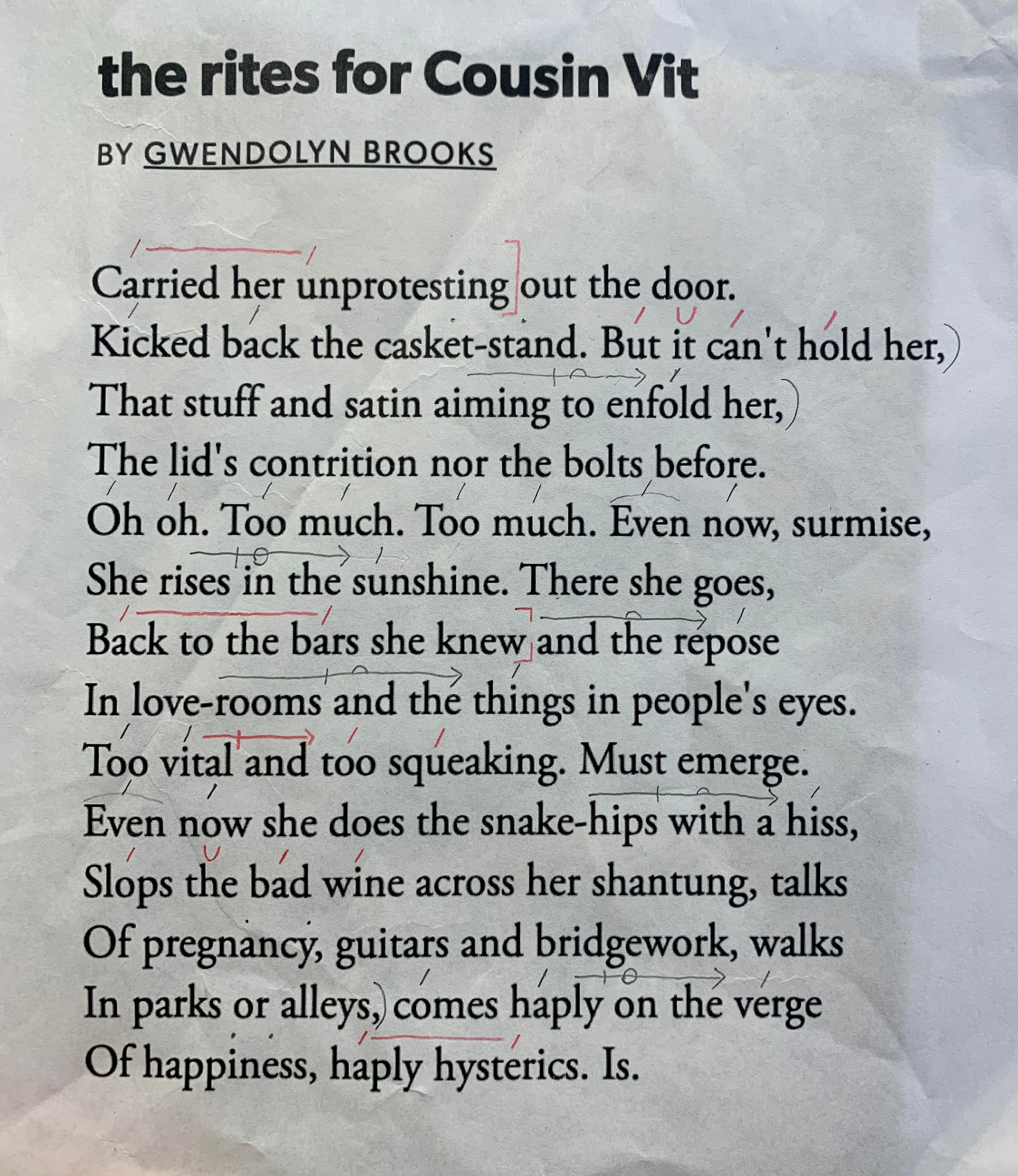
You can also indicate intermediate stress on an offbeat within a march pattern (somewhere half way between fully stressed and fully unstressed, as opposed to slightly less than full stress). The standard notation for a semi-stress is a backslash, which I used in the Macbeth scansion (like so: \ ). I have since decided I find a slanted almond shape less visually jarring (as in “There ain’t no more” in line 4 of Wilfred Owen’s poem below).
I mark appended pyrrhics with a simple dot above each of the two syllables (as in, for instance, the last two syllables of “happiness” in the final line of Gwendolyn Brooks’ sonnet). When the appended pyrrhic forms the first half of a slide, I place those two dots over the arrow - as I did here, for instance, in the slide-march hybrid from Hamlet we looked at earlier (a swing & slide is also circled):
And I mark an arch over contractions (which is the standard notation). Ironic that the middle syllable of “syllable”, in Macbeth’s speech, is contracted: “syll’ble”! As is often the case, this contracted syllable does not disappear altogether, but is reduced to a half syllable, indicating a robust pace to the delivery (you can really feel the violent energy of this speech).
Scansion Tips for Beginners
For beginners attempting to scan metered verse, besides familiarising yourself with the various metrical patterns (especially those containing a beat shift: the swing, the pump, and the catch), I think the single most important tip is this: read the lines out loud and see if you can hear a rhythm, and then mark where you hear the beats. And then check if your beat placements are consistent with the meter.
If they aren’t, and you don’t know why, it’s usually best to start at the end of the line and work backwards.18
Unexpected emphasis
Sometimes you’ll find there’s a beat on a word which you didn’t expect to receive emphasis, for which there will be an expressive purpose intended (I will write a post touching on this).
Changes in pronunciation
Ocassionally, a word may have (or optionally have) a different stress placement in Shakespeare’s day - such as “acceptable” in Sonnet 4:
What acceptable audit canst thou leave?
Expansion & contraction
And sometimes it will be a matter of working out the syllable count: some words can be either expanded, contracted or glided together to fit the meter - even more so in Shakespeare’s day (and I will be writing a comprehensive post on this: it’s too important a topic not to). Examples of optional expansions include the pronunciation of the ‘-ed’ suffix as a separate syllable, and the stretching out of ‘-tion’ or ‘-ssion’ into two syllables (with the short “i” pronounced separately). One common contraction is that of words with a medial V - for instance, “Heaven” may be contracted, via either a lightly pronounced V, “Heav’n”, or by replacing the V with a nasal stop: “Hea’en”. Shakespeare became bolder with his contractions in his later plays, which is why there’s a mistaken perception that his meter became more irregular. Reading the line out loud with pace can often render it easier to identify where a contraction might occur.
As I’ve indicated elsewhere in this post, such contractions often fulfilled a dramatic purpose, contributing a sense of intensity or urgency.
We saw an ecstatic example earlier from Elizabeth’s love sonnet:
Drop heav’ly down,..burst, shattered ev’rywhere!
Here, on the other side of the coin, they help to convey the jealousy driven desperation of Othello in reaction to Desdemona’s failure to produce the handkerchief:-
Is’t lost? Is’t gone? Speak, is’t out o’th’ way?
Consider how much less dramatic the line is without the contractions:
Is it lost? Is it gone? Speak, is it out of the way?
It just doesn’t have the same impact, does it?
Besides the contractions, there is also a metrically distinctive feature to Othello’s outburst: one that distinguishes it from every other line I’ve quoted thus far.
And whenever you wish to go down that rabbit hole, please proceed to Part 2!
A big thank you to those fellow Substackers who took the trouble to read this post in draft and give feedback: Gemma Lynn Myers, Rebekah King, Alan Horn, and Sally Thomas.
Accentual meter is defined by the number of beats in a line, with no specific requirements as to their placement in relation to any surrounding offbeats (often, as in Old English verse, assisted by alliteration. Here’s a website devoted to alliterative verse).
Syllabic meter, a 20th C. invention, is defined by the number of syllables in each line, regardless of stresses.
In this post we are concerned with accentual-syllabic meter, where beat placement among the surrounding offbeats is expected to follow some consistent principles, producing a predictable range of beat patterning.
“A woman’s face with nature’s own hand painted”
Shakespeare’s Sonnet 20 exploits this “feminine” association: every single line has a “feminine ending”!
This catch, unique within his sonnet sequence, from Sonnet 8, deliberately tugs against the unification of grammar and meter:
{Sweets with sweets war} not, joy delights in joy.
Not only does this catch end on a verb, which is unorthodox in itself, but the subject of the verb is the first “Sweets” (“Sweets [war not] with sweets”. Shakespeare moves the words in [square brackets] to the end). The meter requires that you do not pause before “war”, nor drop the pitch on that word. The grammatical tension held within a rhythmic cohesion embodies both tension & unity, conflict & concord.
For a summary of this historical development, read the Introduction to The Strict Metrical Tradition by David Keppel-Jones.
This is formally known as long meter.
This is formally known as half meter.
Or technically, a phantom foot: the beat and its preceding offbeat. If the trimeter is tailed…
di-dum-di-dum-di-dum-di
…then there’s only a phantom beat!
di-dum-di-dum-di-dum-di (dum)
From Milton’s Paradise Lost!
I’m rereading A. E. Housman’s A Shropshire Lad, which only contains one pentameter poem: poem 23 is in anapestic pentameter (two offbeats between each beat, instead of one). It’s intriguing to me that, to my ear, at least, the enlarged 3-beat rhythm resounds more strongly in these lines than in an equivalent iambic line.
This is probably due to the combination of the more insistent pacing of anapestic meter, and the opening beats standing out more emphatically for being preceded by only one offbeat. It is common in anapestic meter that some of the lines open on a single offbeat; in this poem, that’s true of every line. The stress pattern of every line here is:
di-DUM-di-di-DUM-di-di-DUM-di-di-DUM-di-di-DUM
“The Golden Line” & “The Balanced Line” are terms I adopted from Rhythm and Meaning in Shakespeare by Peter Groves.
The hexameter does possess an enlarged default 3-beat rhythm - but divided into three equal parts: three pairs of beats:-
di-DUM-di-DUM | di-DUM-di-DUM | di-DUM-di-DUM
And while a pentameter, with its odd number of beats, cannot divide in half, the hexameter divides into two rhythmic trimeters whenever there is a caesura between the middle beats:
di-DUM-di-DUM-di-DUM, | di-DUM-di-DUM-di-DUM
While the tight but flexible iambic pentameter is the most multi-purpose meter, the elongated iambic hexameter (with a predisposition to split which can be both avoided and selectively exploited) is actually very underrated, in my opinion! I might write a future post on that!
If you were wondering about even longer meters: they invariably break into shorter rhythmic units. The heptameter, for instance, with 7 beats (traditionally known as fourteeners, due to their fourteen syllables), tends to break into rhythmic units of 4 & 3 (common meter rhythm):-
di-DUM-di-DUM-di-DUM-di-DUM | di-DUM-di-DUM-di-DUM
I shall also write a future post on common meter!
Though again, that word: “default”. All that actually means is that if you vocalise that stress pattern with meaningless repetitive sounds, such as “di-dum-dum-dum”, you will find that you drop the pitch slightly on the middle “dum”.
But when it comes to actual words as carriers of meaning and emotion, consecutive heavy syllables readily invite expressive exploration. I sometimes, for instance, find myself raising the last two syllables together, in equal pitch (an elevated spondee, if you like).
Or sliding the pitch on one or more syllables.
We automatically slide syllables at the ends of sentences. We slide up on the last syllable of a question, do we not? But if it’s a statement, and if the final syllable of the sentence is stressed, we slide down. Like that.
And we also often slide a syllable mid-phrase (like this and this) when a word requires rhetorical emphasis. In the case of Hamlet’s “so long life” (in the Hybrids segment), I find it hard to see how anyone wouldn’t slide down on all three syllables! (you might even add a shade more emphasis by sliding slightly up before sliding down). In the first example I gave, “And dig deep trenches…”, there is the option of digging into that word “dig” by sliding on it (you can try that out yourself - and see how that affects your delivery of the next two syllables).
And sliding a syllable can also be an effective way to give rhetorical emphasis to an offbeat - for instance, when Macbeth says…
For Banquo's issue have I filed my mind,
For them the gracious Duncan have I murder'd,
Put rancours in the vessel of my peace
Only for them, and mine eternal jewel
Given to the common enemy of man,
{To make them kings}, the seeds of Banquo kings.
I have only scanned the last line, and marked the previous two instances of “them” in beat positions - which I automatically find myself sliding on, with venomous disgust. And I read that final “them”, in its offbeat position, in exactly the same way! (You could alternatively slide up instead, or up then down; so long as you do slide it, the following word, “kings”, will meet it with the same energy).
Some people reading this line (especially out of context) will, instead of sliding, deliver that offbeat “them” with a quick high pitch (which, delivered between two long syllables, is perhaps the only exception to pitch being the primary denominator of stress). However, such a delivery on an offbeat tends to flatten the rest of the phrase - in this instance, only the one word, “kings”, which will drop further in pitch instead of sliding (as a beat at the end of a phrase normally would). To my ear, this flattening effect within metered verse does not serve heightened dramatic speech (though it might be a legitimate way to emphasise an offbeat where a poem is written in a colloquial voice).
Aka feminine caesura. Take your pick! Technically, the lyric caesura is one of two types of feminine caesura (meaning a caesura after an offbeat). I will be covering the other type in Part 2.
This line, from Sonnet 129, which I already shared twice, commenting first on its split swing, and then on its split spondee, follows up with a lyric caesura!
{Savage, extreme}, {rude, cru}el, ¦ not to trust;
And if you revisit the excerpt I shared from The Tempest, you will note how I described Prospero as “picking up the beat” - after a lyric caesura. They keep coming!
                                                               ¦ Fair encounter
{Of two most rare} affec{tions. ¦ Heav’ns rain grace}
On that which breeds between ’em! ¦

Ferdinand
Wherefore weep you?
Later editions take some minor liberties with Elizabeth’s original texts - including “correcting” some of her ellipses to dashes.
Though Shakespeare was working with the pallete that belonged to his own accent! We can only generalise on what that may have sounded like, but we can reliably say that it was a rhotic accent (he pronounced his Rs), and that the diphthongs we hear in modern Received Pronunciation (where two vowels are glided together, as in cow, flow, mine, play, etc.) were relatively flattened; which also means there is a smaller range of vowel sounds, and so assonance - the repetition, or near repetition, of vowel sounds - is more frequent, which in turn provides more opportunity for puns (lost to us in Received Pronunciation, alas!) The schwa (the most neutral vowel) is more prevalent - including in diphthongs. When you successfully adopt any approximation of the accent, you will likely find your voice drops lower into your body.
A.Z. Foreman has some interesting things to say about Original Pronunciation as promoted by David Crystal. He also has a Patreon account, where you can hear his Shakespearean deliveries.
Not everyone realises it continues:
Made glorious Summer by this Son of York
There’s a theory that Shakespeare intended the repetition of a phoneme at the end of one word and at the beginning of the next to be a cue to the actor to enunciate each separately. Here, that results in picking out the words “Summer” & “son”:
Made glorious ¦ Summer by this ¦ Son of York
I don’t think this practice always works, but it is always worth trying out. Here, out of the mouth of the conniving, bitter, malicious Richard, I feel it makes the delivery just that much more dramatic!
You could also start off practising with poets who specialise in short meters, such as A.E. Housman and Emily Dickinson. Readers are welcome to suggest their own favourites!
This is great. I think the article on contractions will be useful, it's one of the most misunderstood techniques by contemporary poets, even die-hard metrists. So often I'll see what should be a blatantly obvious contraction, but, because the editor didn't include an apostrophe in the text, the supposedly die-hard metrist will declare that it's a metrical substitution!
I wonder also if it might not benefit beginners to have a guide for how your system differs from what they'll hear from other metrists. I think your method is fine, but the people who learn from it might want to go out into the real world and read scansion from other writers as well and could get very confused, for instance, when they see a pump-forward scanned as just two standard iambs, which is the norm.
Both basic and original. Absolutely convincing categories and examples. It'll take me a few reads to absorb this all, but I appreciate having it all in one place. Thank you!