
The Multifaceted Pentameter: An English Sonnet
How does a poem draw a circle around itself?

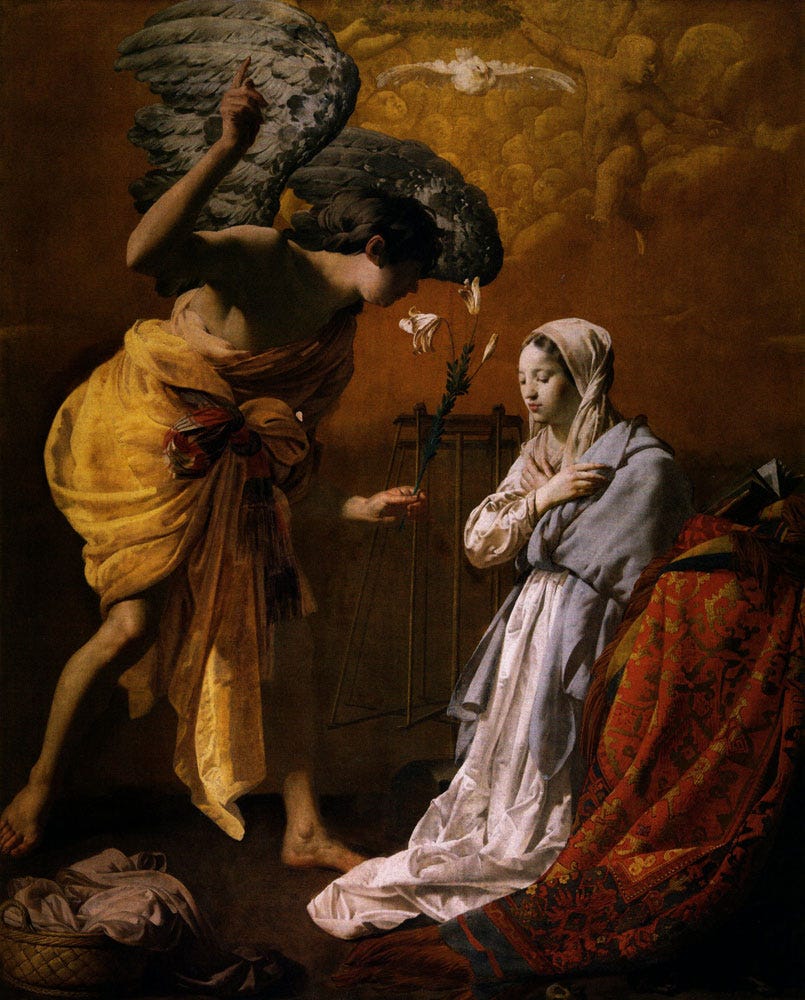
J.C. Scharl’s Annunciation offers a strikingly original perspective on a famous story (and you need not be a Christian to appreciate the artistry).
In this post, we’ll explore, via Jane’s own exploitation of the form, the English sonnet.
In addition, her beautifully efficient employment of offbeat omissions (mainly jolts, of which there were none in Sylvia’s serpentine offering) allows us to continue exploring the expressive employment of unorthodox variations.
A quick reminder of my approach to scansion:
I mark beats in italics.
I mark heavy syllables in bold.
I mark heavy beats in bold italics.
I enclose variant stress patterns in {curly brackets}.
I mark syllable omissions with an underscore: _
I mark lyric caesuras (a caesura after an offbeat) with a broken pipe symbol: ¦
And, with gratitude for the new Substack colour options, I shall henceforth, in place of brackets, colour patterns that contain a beat shift in red. Of which there is one example in this sonnet.
Here’s the sonnet, followed by a scansion.
Annunciation by J.C. Sharl
Beyond the brimming ages Gabriel waits,
his foremost message burning on his breath.
Through time men slide, creeping through the gates
of birth and out again the doors of death.

He sees kings rise and kingdoms fall to dust;
he sees unnumbered souls unfleshed; to some
he gives slight hints, but the full knowledge must
wait, for his best words are not for them.

Then at last, coming from afar
he sees, gleaming like a golden pin
in time’s folds, Mary, rising like a star
above the fretted seas of what had been.

Bright hinge on which the gate of Heaven creaks;
to her he turns, inclines himself, and speaks.
And my own scansion:
Beyond the brimming ages ¦ Gabriel waits,
his foremost message ¦ bur{ning on his breath}.
Through time {men slide}, _ cree{ping through the gates}
of birth and out again the doors of death.{He sees kings rise} and kingdoms fall to dust;
he sees unnumbered souls unfleshed; to some
{he gives slight hints}, but the full knowledge must
_ wait, {for his best words} are not for them._ Then at last, _ co{ming from afar}
he sees, _ glea{ming like a gol}den pin
{in time’s folds, ¦ Ma}ry, ¦ rising like a star
above the fretted seas of what had been;{bright hinge} on which the gate of Heaven creaks,
to her he turns, inclines himself, and speaks.
(The stress level of the “un-” prefixes in “unnumbered” & “unfleshed”, and the first syllable of “inclines”, are indeterminate, so read them as the humour takes you!)
The original Italian (or Petrarchan) sonnet structure divides the 14 lines into two unequal parts: an octave (an 8-line stanza)….
ABBAABBA
…followed by a sestet (a 6-line stanza), which can follow a number of rhyme schemes. The most common are…
CDECDE
and…
CDCDCD
The octave would lay out a problem or observation, and the shorter sestet would provide a response or resolution (the switch from the octave to the sestet is called the volta).
Jane’s sonnet, meanwhile, is an English (or Shakespearean) sonnet: three quatrains of alternating rhyme and a final couplet:
ABAB CDCD EFEF GG
Many English language sonnets have been written in the Italian form (and any number of forms, in fact), but this is an early English adaptation.1 Note that it is still divisible into an octave and sestet; it simply subdivides both.
It divides the octave in half…
ABAB CDCD
…and the smaller sestet itself into two unequal parts:
EFEF GG
The Italian form has a more liquid quality than the English, with its accumulative progression of three quatrains, which is then tied up with a final couplet. This presents the challenge of finding a couplet that provides a truly satisfying conclusion - one that feels earned.
Jane makes her couplet the awaited culmination of the whole of human history up till that point. There’s no topping that!
If we look at her sonnet as an organic whole, there are three defined temporal stages through the three quatrains.
Gabriel first “waits”, his untold message “burning” with the intensity of fire.
Over the passage of time, he “gives slight hints”.
Until “at last” he sees Mary “coming from afar”.
And in a macrocosm to microcosm move, the final line, the golden moment in time, is itself divided into three simple sequential actions:
To her he turns,
inclines himself,
and speaks.
Embedded within the English sonnet structure we find an Italianate volta, where the simple adverb, “Then”, opens the sestet. There are techniques she employs to heighten this transition, which we’ll come to.
I will sometimes refer to the quatrains by the shorthand of Q1, Q2 & Q3.
Let’s dive in!
The Octave
The Opening
For this opening 2-line sentence, I’m going into exceptional detail on the prosody.
Beyond the brimming ages ¦ Gabriel waits,
his foremost message ¦ bur{ning on his breath}.
Suppose that first line were…
Gabriel waits beyond the brimming ages,
This linear syntax, opening with subject and verb, merely begins a story which we passively absorb.
Beyond the brimming ages ¦ Gabriel waits,
This inverted syntax provides immediacy: we are flung straight “Beyond the brimming ages” without mediation; and when the subject and verb does land, in a tight coil at line’s end, we’re immediately waiting with him in suspense!
This simple grammatic inversion compresses distance, providing a tension which uncoils throughout the quatrain (we will see non-linear syntax writ large in Q3).
Simultaneously, this relineation provides a grounded sonic equilibrium: the word occupying the middle beat, “ages”, both concludes the prepositional phrase after its opening alliteration (“Beyond the brimming…”), and initiates a string of assonance with “Gabriel waits,”.
And yet it’s also an elegant contraction from the prepositional phrase to the verb phrase.
The prepositional phrase opens and closes on an an offbeat…
Beyond the brimming ages…
…, and the short middle beat (“brimming”) provides a swift bounce between the long syllables on the 1st & 3rd beats. Seen this way, it’s elegantly symmetrical.
The symmetry of the verb phrase, meanwhile, is ultra-contracted to a simple “dum-di-dum”, with a matching long vowel on the two beats:
Gabriel waits,
Simultaneously, “Gabriel waits” provides a subtle containment of the expansive “brimming ages”: the bold “bri-” of “brimming” is now enclosed within the fall of “Gabriel” (where his name is delivered tightly to count as two syllables) - while the sustained call of the “ay” in “ages” is picked up, echo-like, within the name’s matching initial stress (Gabriel), before reaching the monosyllabic “waits”, the unvoiced “-ts” sharply curtailing the diphthong’s duration.
Within the form of the archangel, “the brimming ages” compress into a static contained energy: “Gabriel waits,”.
Line 2:
Beyond the brimming ages ¦ Gabriel waits,
his foremost message ¦ bur{ning on his breath}.
Matching “brimming ages”, line 2 has an even earlier pair of falling disyllables, “foremost message”, and the long vowel this time lands “foremost” on the first falling word.
And where line 1 closes on the tight assonating coil of…
…Gabriel waits,
…line 2 closes on the intense, alliterating expansion of:
…bur{ning on his breath}.
In repeating the opening alliteration (“Beyond the brimming…”), it also releases the nasal labials, the Ms, of the first half of the line (“his foremost message…”) into labial plosives (make an mmm sound: if you open your lips to allow the air to come out your mouth instead of your nose, it releases into a plosive B!). And in a more subtle vowel shift, within a near double assonance (“his foremost message ¦ burning on his breath.”), the open “ore” of “foremost” shifts forward into the “ur” of “burning”.
Just in these opening two lines, we have layers of repetition, symmetry, contrast, tension, contraction and expansion.
The Rhymed Progression
Beyond the brimming ages ¦ Gabriel waits,
his foremost message ¦ bur{ning on his breath}.
Through time {men slide}, _ cree{ping through the gates}
of birth and out again the doors of death.
Another 2-line sentence completes the quatrain, and again opens on a syntactic inversion - this time, in a mere four syllables: “Through time men slide,”. While “Gabriel waits,”.
And we reach the culmination of a progressive expansion in the end-line phrases.
First, the tight assonating coil of…
…Gabriel waits
…through to the alliterating expansion of:
…bur{ning on his breath}.
And finally, as we switch to an angel’s eye view of the whole of humankind, through their ever passing, ever renewing generations, the middle offbeat is snipped away, and the same end-line pattern repeats - but this time carrying us to, and through, the “gates” of an enjambment.
                                             _ cree{ping through the gates}
of birth and out again the doors of death.
The repeated end-line pattern is this time semi-alliterated: in a repetition with difference, the unvoiced K of “creeping” meets its voiced cognate in the G of “gates”: “creeping through the gates”.
On the other side of the enjambment, the “birth” & “death” which begin & end the final line expansively echo the intimate close of the first sentence: “burning on his breath.” And as, generation by generation, they depart through “the doors of death”, Gabriel’s “foremost message” awaits revelation.
The 2nd Quatrain
{He sees kings rise} and kingdoms fall to dust;
he sees unnumbered souls unfleshed;
“He sees Kings rise” picks up from “Through time men slide,”. We shift from the whole race of “men” to the “kings” who rule over them - whose individual “rise” is insignificant relative to the inevitable “fall to dust” of any number of “kingdoms”.
In the opposite direction, we then shift from “men” to “souls”: what remains, “unfleshed”, after passing through “the doors of death”.
Within “unnumbered souls unfleshed”, the negating “un-” prefix transforms two adjectives in contrasting directions: the finite “numbered” into the infinite; the corporeality of “fleshed” into its absence (and isn’t “unfleshed” a striking coinage!)
{He sees kings rise} and kingdoms fall to dust;
he sees unnumbered souls unfleshed; to some
{he gives slight hints}, {but the full know}ledge must
_ wait, {for his best words} are not for them.
The succeeding syntactic inversion is heightened by enjambment (the linear version, “he gives / slight hints to some,” is inverted: “to some / he gives slight hints,”).
While the grand display within which “kings rise and kingdoms fall” plays itself out, the archangel “gives slight hints” while preserving “the full knowledge” (the G of “gives” is the voiced cognate of the K of “kings”; the voiced D of “kingdoms” is hushed to its unvoiced cognate, “hints”).
There is a diminution, a tightening, from “fall” to “unfleshed”, and from "souls” to “slight” - to be succeeded by the robust “full knowledge”.
That final line is headless (omitting the opening offbeat) - but it combines with an enjambment to form what is in effect a drag!
{but the full know}ledge must _ wait,
The stress pattern immediately preceding the enjambment is striking:
BUT the FULL KNOWledge MUST
That “DUM-di-DUM-DUM” pattern is what I call a “catch” - which in this instance is immediately followed by an end-line iamb, forming a fortress-like pattern: a double stress contained within the outer walls of two beats - a robust symmetry reinforced by the outer assonance: BUT…MUST
A stress fortress to protect “the full knowledge”!
She does something clever with the rhymes here: “…them” is the only slant rhyme in the sonnet {some/them}; and (though anticipated by “unfleshed;”) it is the only end-line word in the stanza that doesn’t assonate with the rest {dust/some/must/them}.
The lack of a full end rhyme for “some” is compensated - in a movement from the infinite to the finite - by its internal rhyme with “unnumbered”.
The Sestet
The 3rd Quatrain
“…them”, meanwhile, is met by the opening word of the sestet, differing only in a different nasal at the end (“…them. / Then…”):
_ Then at last, _ co{ming from afar}
he sees, _ glea{ming like a gol}den pin
{in time’s folds, ¦ Ma}ry, ¦ rising like a star
above the fretted seas of what had been;
That subtle pricking out of the final rhyme word of the octave serves as a springboard into the sestet - its matching monosyllable itself pricked out through the omission of the introductory offbeat. And we are flung into an echo and intensification of the expansions which opened the octave.
In this one line, served by its opening and medial jolts…
_ Then at last, _ co{ming from afar}
…we see, within what is this time a quick staccato, the initiation of the same progressive expansion we saw at the line-endings of the first half of Q1:
…Gabriel waits
…bur{ning on his breath}.
And whereas in Q2, it is Gabriel initiating communication “to some”, it is now Mary who is “coming” to him.
And the final jolt, in the very next line, marks a super expansion:
_ Then at last, _ co{ming from afar}
he sees, _ glea{ming like a gol}den pin
in time’s folds,
Compare…
             _ glea{ming like a gol}den pin
in time’s folds,
…to the final expansion in Q1, on line 3:
                                             _ cree{ping through the gates}
of birth
The sestet is taking everything up a notch. (Note, too, the service of the enjambments: in Q1 it carries us through “the gates”; in Q3 it carries us over a fold!)
Further sonic techniques heighten the eventual pinpoint landing of “pin”: the UH of “coming” expands into the AH of “afar”, itself building on the assonating “last”; the K of “coming” meets its voiced cognate in the G of “gleaming…golden…”, which words themselves augment the “gl” of “gleaming” with the OH of “golden”; the EE of “…sees, gleaming…” contracts into the “i” of “pin”; and “pin” itself is enfolded either side by “…golden…folds…”.
If we return to an overview of the whole quatrain…
_ Then at last, _ co{ming from afar}
he sees, _ glea{ming like a gol}den pin
{in time’s folds, ¦ Ma}ry, ¦ rising like a star
above the fretted seas of what had been;
…we see a rearrangement of syntax writ large. Here’s how a syntactically linear phrasing might read:
“Then at last he sees Mary coming from afar, gleaming like a golden pin in time’s folds while rising like a star above the fretted seas of what had been.”
Doesn’t have the same ring!
“Then at last he sees Mary coming from afar,” sounds pedestrian. This is in part because it’s robbed of the impetus of metered rhythm, but only in part.
And to be simultaneously “gleaming like a golden pin [within] folds” and “rising like a star above the…seas” - it doesn’t really gel.
So how is it rearranged? “Mary” is plucked from the middle of the first half, and ensconced in the middle of the second:
“Then at last he sees Mary coming from afar, gleaming like a golden pin in time’s folds while rising like a star above the fretted seas of what had been.”
“Then at last, {coming from afar} / {he sees}, gleaming like a golden pin / in time’s folds, Mary, rising like a star / above the fretted seas of what had been.”
The phrases either side of “Mary” in the linear version are swapped, which both delays subject & verb and brings our own immediate attention on the anticipated object.
Anticipation which is then sustained by the first simile, which now intervenes between verb & object. This simile presents to us the object: “gleaming like a golden pin in time’s folds,” who? “Mary,”.
The second simile renews the movement needed to carry us to the end of the quatrain, while providing another frame within which to comprehend her supreme temporal significance: the first, “gleaming like a golden pin / in time’s folds”, being highly abstract, and implicitly invoking an agent outside of time utilising the “golden pin”, places no primary focus on either past or future; the second, “rising like a star / above the fretted seas of what had been”, in conjoining the celestial and terrestrial, employs a familiar and eternal image, and one that is imbued with movement - movement in relation to “what had been”, preparing the way for the awaited moment.
And note how the urgency of opening stresses is maintained (“Then…coming…gleaming…Mary, rising…”) - initially through jolts, and now through lyric caesuras, the enthroned “Mary” following one lyric caesura and preceding another
The Couplet
{bright hinge} on which the gate of Heaven creaks,
to her he turns, inclines himself, and speaks.
The first line is filled out with a noun phrase: Mary in metaphor.2 The opening inversion of the next line, “to her he turns”, is momentously weighted, “to her” referring back to Mary metaphorised as the “hinge” on which all depends. The “bright hinge” on the other side of the “brimming ages” through which “Gabriel” has been waiting to deliver his “foremost message” with “burning…breath.” Fittingly, “bright hinge” is the only opening spondee in the whole sonnet.
This closing couplet is a compact singularisation of that opening quatrain.
Beyond the brimming ages ¦ Gabriel waits,
his foremost message ¦ bur{ning on his breath}.
Through time {men slide}, _ cree{ping through the gates}
of birth and out again the doors of death.…
{bright hinge} on which the gate of Heaven creaks,
to her he turns, inclines himself, and speaks.
In shape, both divide into equal halves, of which the second half divides asymmetrically.
And here’s the opening of the second half of quatrain & couplet:
Through time men slide,
To her he turns,
From the expanse of “time”, through which generations “slide”, to this moment, as Gabriel “turns” at this spot, to address this woman: the “bright hinge” of a single supreme “gate”:
creeping through the gates
vs
the gate of Heaven creaks,
In one last intentional, individuated movement, Gabriel, in contrast to the undifferentiated, perpetual manner in which “men slide”,
inclines himself,
The omniscient octave
The quatrains of the octave, Q1 & Q2, combine to prefigure the couplet:
{He sees kings rise} and kingdoms fall to dust;
he sees unnumbered souls unfleshed; to some
{he gives slight hints}, {but the full know}ledge must
_ wait, {for his best words} are not for them.…
{bright hinge} on which the gate of Heaven creaks,
to her he turns, inclines himself, and speaks.
“…slight hints” of the “bright hinge” to come! And that same line closes on the “hinge” of an enjambment!
The final line of Q2 has a similarity with that of Q1:
“{of birth} and out again | the doors of death.”
“{wait,} for his best words | are not for them.”
After the overrun from the preceding enjambment, in both cases, the remainder of the line has eight syllables, in a purely rising rhythm, which divide neatly into two syntactic groups of four. And this matches the first eight syllables of the final line of the couplet:
“{of birth} and out again | the doors of death.”
“{wait,} for his best words | are not for them.”
“to her he turns, inclines himself,”
I have also marked the matching assonances (not to mention the rhyming “wait…gate”).
Q1, apprehending the cycle of life, terminates on “death”.
Q2 concludes on a note of containment: on the necessity of delaying the “full” message.
But now is the time to deliver.
to her he turns, inclines himself,
and speaks.
On the history of the adoption of this rhyme scheme, this is a fascinating article! https://www.ox.ac.uk/news/features/mystery-first-english-sonnet
Apparently, the sestet reformulates traditional epithets of Mary: Domus aurea, “house of gold”; stella matutina, “morning star”; stella maris, “star of the sea”; and, climactically, Ianua caeli, “gate of heaven.” Thanks to Robert S Miola for this beautiful insight!
I Love this poem! I saved a hard copy of it when I first saw it. Thanks so much for sharing this in - depth review!
Thanks for such a close read.